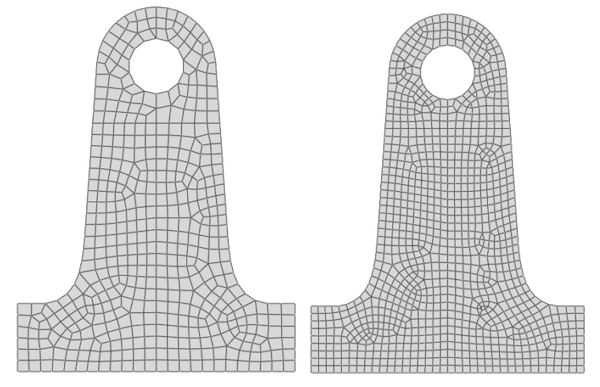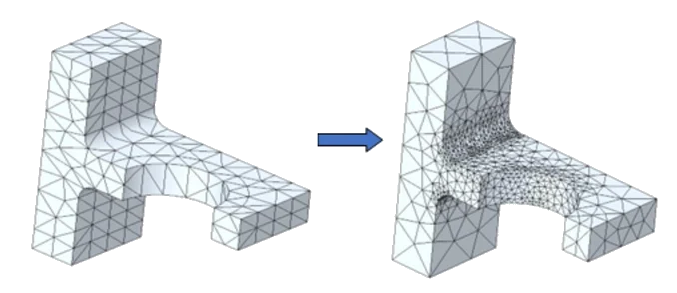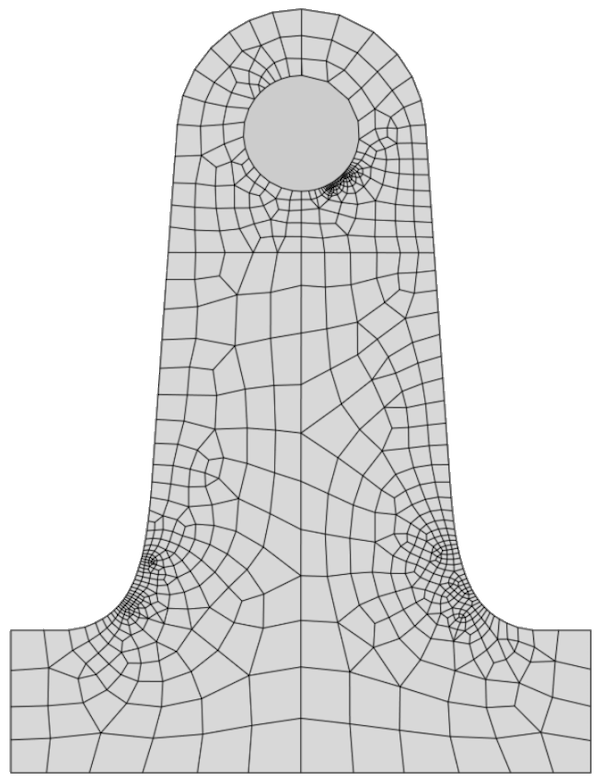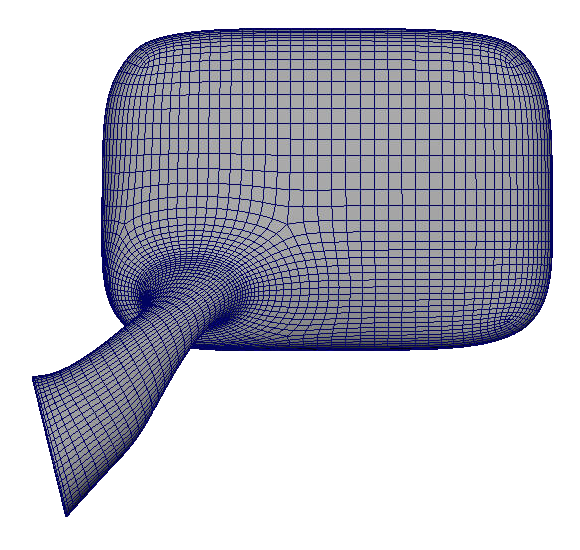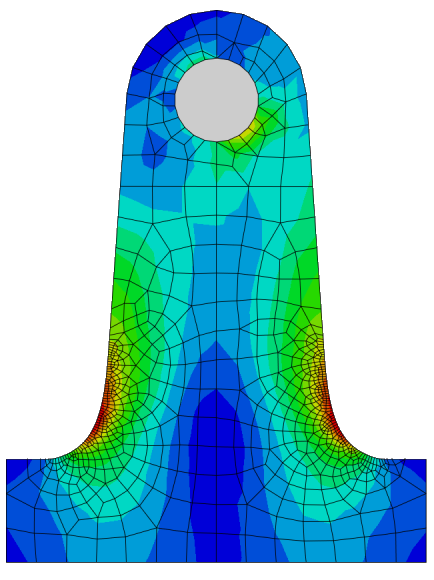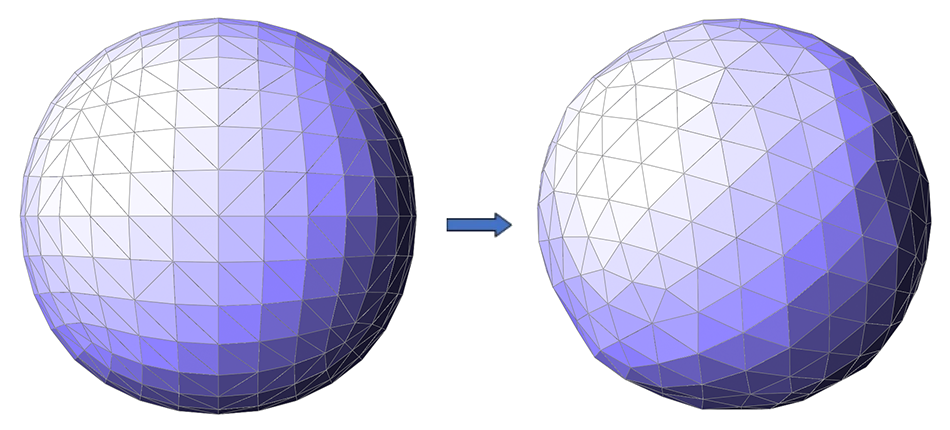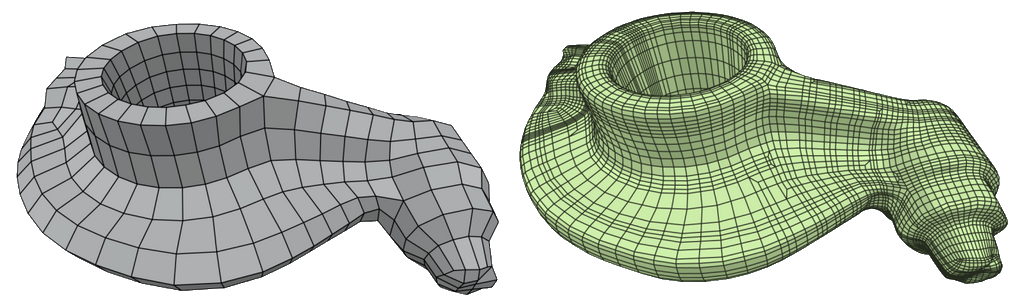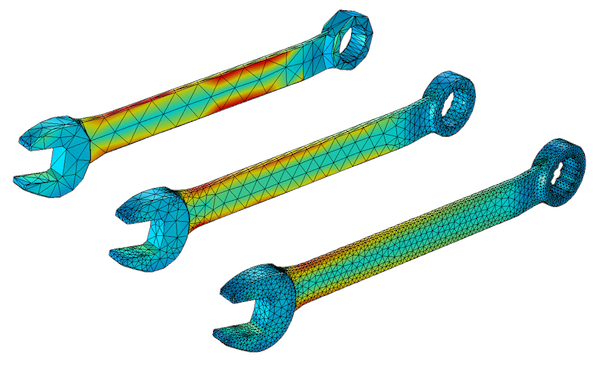
Refinement is the mechanism that determines where resolution is allocated within a mesh. It transforms a coarse geometric approximation into a discretization capable of supporting accurate numerical simulation. While segmentation partitions geometry into meaningful regions, refinement controls the size, density, and alignment of elements within those regions.
In numerical simulation, the accuracy of a solution depends critically on the mesh. Let u denote the exact solution of a governing equation and u_h its discrete approximation on a mesh \mathcal{T}_\mathcal{h}. The discretization error satisfies:
\[u-uh≤C,hp\]
where h represents a characteristic element size and p the order of the numerical method. This relationship highlights a fundamental principle: reducing error requires reducing element size—but only where necessary.
Naïve refinement strategies that uniformly reduce h across the domain lead to excessive computational cost. Effective refinement instead seeks an optimal distribution of resolution.
In modern simulation workflows, refinement is essential for both accuracy and stability. Numerical solvers rely on well-resolved curvature, sharp features, boundary layers, and stress concentrations. When refinement is insufficient, simulations suffer from numerical noise, instability, and misleading results. When applied effectively, refinement produces meshes that are both computationally efficient and physically predictive.
At its core, refinement is not about increasing element count, but about placing resolution where it matters most.
This article presents the principles that govern mesh refinement, the criteria used to guide it, and the strategies employed in high-quality mesh generation.